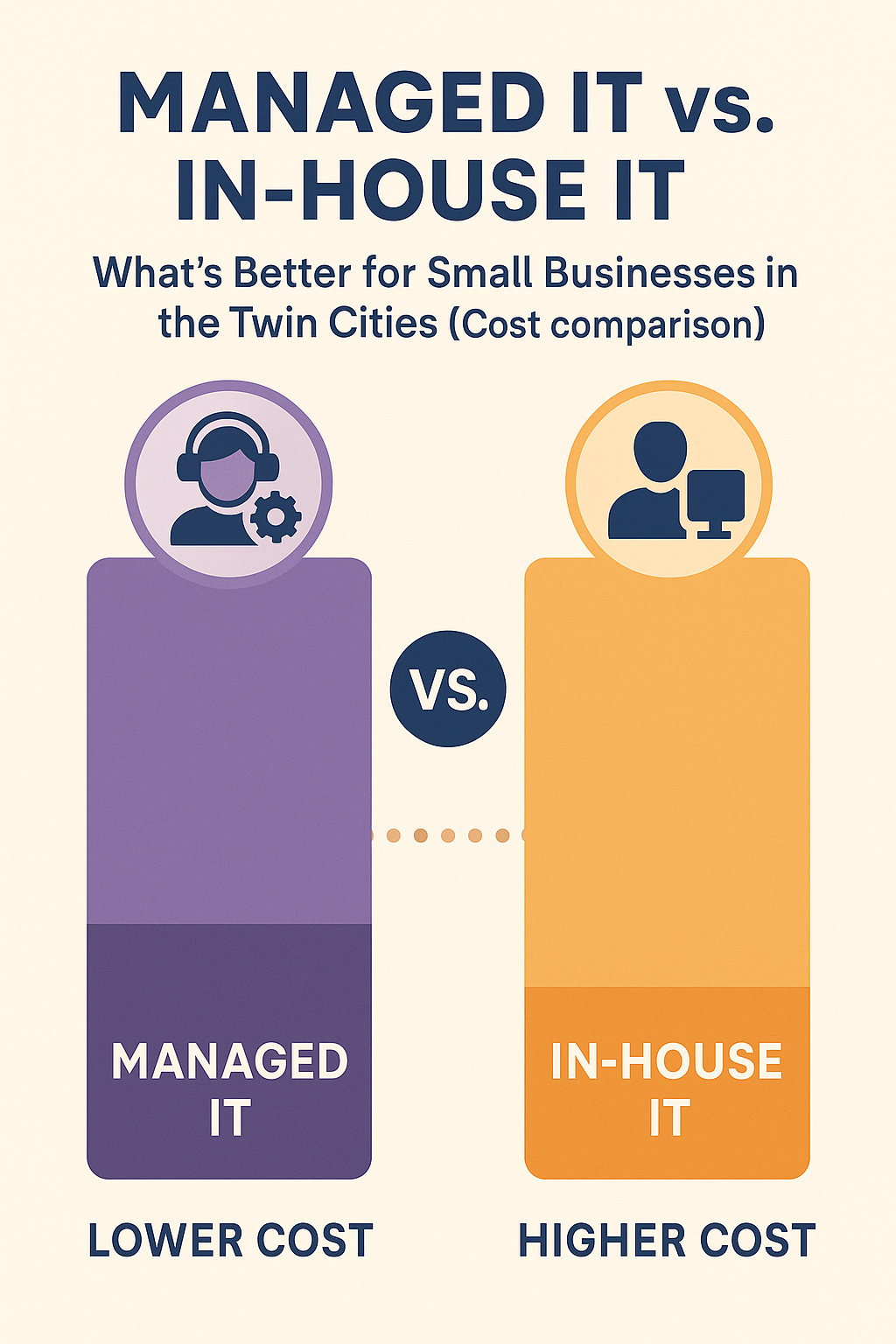
Managed IT services offer small Twin Cities businesses cost savings, 24/7 support, and scalable technology without hiring full-time staff. In-house IT provides greater control and on-site availability but often costs more. For most small businesses, partnering with a Managed IT provider like Vodigy Networks delivers the best balance of affordability, security, and expert support.
1. The IT Dilemma Facing Small Businesses
In today’s business world, technology isn’t a luxury; it’s the backbone of productivity, communication, and growth. For small businesses in the Twin Cities, staying connected, secure, and efficient often depends on how well their IT operations are managed.
Yet, one key decision continues to challenge business owners: Should you build an in-house IT team or partner with a Managed Service Provider (MSP)?
Both options offer unique benefits, but also come with trade-offs in terms of cost, scalability, and expertise. This article breaks down the pros and cons of each model and helps you determine which path fits your small business best especially if you’re exploring local IT services Twin Cities businesses rely on in Minneapolis or St. Paul, or searching for a managed IT service near me to support your technology needs.
2. Understanding the Two Models
Managed IT Services
Managed IT Services involve outsourcing your technology needs to a third-party provider that proactively manages your infrastructure, security, and support for a predictable monthly cost. Local Twin Cities providers like Vodigy Networks deliver complete, end-to-end IT solutions tailored for small and midsize businesses, covering everything from helpdesk support and data backups to cybersecurity and compliance. Access to managed IT services in Minneapolis gives you enterprise-grade support without the overhead of hiring internally.
In-House IT Team
An in-house IT team means hiring your own staff members to handle all IT operations internally. This might start with one or two employees who manage user support, maintain systems, and implement technology upgrades.
The advantage is familiarity: internal IT professionals understand your company’s workflows, culture, and tools intimately. However, this comes with challenges salaries, benefits, and training costs quickly add up, and scaling an internal team can take months or even years.
3. Cost Comparison: Predictability vs. Overhead
For many small businesses, the biggest factor in this decision is cost.
In-House IT Costs
Building an internal IT department requires significant investment:
- Annual salaries (often $70–$120K per IT professional)
- Employee benefits and payroll taxes
- Hardware, software licenses, and tool subscriptions
- Training and certifications to stay current
Unexpected expenses like replacing aging servers or recovering from a cyberattack can strain budgets.
Managed IT Costs
Managed IT services operate on a fixed, predictable monthly subscription. Packages are typically customized to your size, infrastructure, and needs.
For example, a Twin Cities business with under 50 employees might pay $3,000–$5,000 per month for fully managed IT far less than maintaining full-time staff.
The result? Predictable costs, fewer surprises, and a partner responsible for keeping your systems running smoothly.
4. Expertise and Coverage: Access to Specialists vs. Limited Skill Sets
Technology evolves fast, and keeping up requires expertise in cybersecurity, cloud computing, networking, and data compliance.
An in-house IT technician may excel at desktop support or server management, but it’s unrealistic to expect deep knowledge across every area. Gaps in expertise often lead to inefficiencies or missed vulnerabilities.
With Managed IT, you gain access to an entire team of specialists. MSPs like Vodigy Networks employ experts in network security, cloud migration, Microsoft 365 administration, and more giving you enterprise-grade support without the enterprise-grade costs.
Example:
A Twin Cities manufacturer once struggled with unstable network performance and inconsistent email uptime. After partnering with Vodigy Networks, the business gained continuous network monitoring, optimized cloud email management, and stronger data protection all under one service contract. This level of coverage is exactly what many companies mean when they search for a managed IT service near me.
5. Scalability and Flexibility
As your company grows, your technology needs to expand more employees, more data, more systems.
In-House IT
Scaling internally usually means hiring new staff, purchasing more equipment, and increasing training budgets. Each of these steps takes time and money.
Managed IT
In contrast, Managed IT scales instantly. Need to onboard ten new users? Your provider can add them on the same day. Planning a remote office or hybrid setup? MSPs can deploy cloud infrastructure and secure connections without disruption.
For small businesses in the Twin Cities, where growth and seasonal demands fluctuate, this scalability ensures your IT resources always match your business needs.
6. Reliability, Security, and Compliance
Cybersecurity threats have grown exponentially, especially for small and midsize businesses that often lack robust defenses. Minnesota companies are not immune; phishing attacks, ransomware, and data breaches affect organizations of all sizes.
Managed IT Providers
Managed IT providers deliver round-the-clock monitoring, advanced endpoint protection, and automated backups. They stay on top of evolving compliance standards such as HIPAA, PCI DSS, and SOC 2, ensuring your business remains secure and audit ready.
At Vodigy Networks, proactive IT management is a core principle. Their approach includes continuous system monitoring, regular vulnerability assessments, and strategic technology planning so your business is always protected and optimized for performance.
In-House IT
An in-house team can also enforce strong security policies, but maintaining 24/7 vigilance is tough for small teams. Nighttime or weekend outages might go unnoticed until employees return to work, which can mean costly downtime.
7. Control and Customization
Control is one of the biggest arguments for keeping IT in-house. Internal teams report directly to leadership and can instantly respond to requests or policy changes.
However, modern MSPs have evolved. Through Service Level Agreements (SLAs) and dedicated account managers, you maintain full visibility into performance metrics, ticket response times, and system health.
With a local MSP like Vodigy Networks, you also gain personalized service combining the convenience of outsourcing with the familiarity of working alongside a trusted Twin Cities partner.
8. Real-World Scenarios: Which Is Right for You?
Let’s look at how this decision might play out for different business types:
- Startups or small firms (under 25 employees): Managed IT is usually the best fit. It offers professional support and security at a manageable monthly cost—ideal for those seeking a dependable managed IT service near me.
- Mid-sized companies with proprietary systems: A hybrid model works well one internal IT lead for day-to-day needs, supported by an MSP like Vodigy Networks for infrastructure and cybersecurity.
- Highly regulated industries (healthcare, finance, legal): Managed IT ensures compliance with data regulations, automated backups, and proper documentation.
When evaluating your options, consider your growth stage, technology complexity, and long-term goals.
Conclusion
Both Managed IT and In-House IT can support small businesses – but in different ways.
If your business values cost efficiency, scalability, and 24/7 protection, Managed IT is the clear winner. It lets you focus on growth while experts handle your technology through proactive support, security, and managed IT system optimization. On the other hand, if you need hands-on control and run highly specialized systems, in-house IT may be a better fit.
For most small businesses in the Twin Cities, however, Managed IT Services offer the smarter, more flexible path forward, especially for those actively searching for a managed IT service near me to support long-term success.
Ready to simplify your IT strategy?
Contact Vodigy Networks today to explore a t/ailored managed IT plan designed specifically for your business needs.